
Kindergarten Readiness Through Play
Can Play Really Prepare my Child for Kindergarten?
For parents just diving into the play-based preschool world, this is always a top concern, and a valid one. The last thing any parent wants is for their child to be "behind" or to struggle compared to their peers. This is why a lot of early childhood education programs use playful activities over play. They continue to give into the pressure of teaching 3 and 4-year-olds letter tracing, names of letters, and drill them on counting or shapes.

So that's what parents expect - circle time, letter of the week, and cute crafts of shape trains. But here's the truth - those skills are not good indicators of academic success.
A child who knows their letters and can count to 20 may know the answers in Kindergarten, but that doesn't mean they are ready to be in a Kindergarten classroom. In order to function well academically in a Kindergarten classroom, children need strong executive function skills. (For now, we will focus solely on executive function, but I will share more about the physical skills needed for classroom success later.)
What is Executive Function?
Executive function is comprised of three main components:
Working memory - the ability to hold and use information
Inhibitory control - impulse control, self-regulation
Cognitive flexibility - the ability to adapt to changes, shift thinking, problem-solve
In a classroom, those skills may look like:
Waiting for a turn or waiting to speak
Following multi-step directions to complete a task
Managing frustration when something doesn't work or something is challenging
Being able to switch tasks when directed to (transitions)
Why Traditional Preschool Often Gets It Backwards
First and foremost, there is a pressure for teachers to prove learning. Adults are focused on teaching the outcomes - the tangible evidence of learning - before the brain is actually ready. Traditional preschools that push early academics are attempting to shortcut the development process and the children are paying the price.
If the brain has not formed the connections necessary to use the information given, conceptualize complex ideas, or regulate the body long enough to focus on new information, then higher learning cannot take place.
Overly structured environments limit opportunities for children to:
Make decisions for themselves
Solve problems independently
Experience natural consequences that impact future behavior
Practice self-regulation
Develop intrinsic motivation or pride
These environments can create Kindergartens who:
Make poor decisions because they haven't needed to make decisions before
Need constant support for simple challenges
Don't understand the impact of their behavior or will repeat undesirable behaviors
Meltdown when challenged or asked to switch tasks
Need teacher attention and recognition every step of the way
Without the building blocks of executive function skills, not only have we ignored the child's development process, but we've set them up for failure (not to mention, set the Kindergarten teacher up for a year of stress and daily battles.)
How is Executive Function Developed?
Executive function is developed through experience! Which in a preschooler's world means through play.
If the adult always decides for the child, always co-regulates, or always plans for the child, then the child themselves have no need to develop executive function skills.
Instead, open, child-led play provides countless opportunities to develop these skills.
Executive Function Built by Play
Unstructured play allows for multiple opportunities for each component of executive function to develop side-by-side.
Working memory in action may look like:
Holding rules of a game in mind
Staying in character
Remembering peer's roles in pretend play
Learning from natural consequences
Inhibitory control may look like:
Waiting for a turn
Negotiating with peers and resolving conflicts
Managing big emotions (excitement, disappointment, frustration, etc)
Controlling impulsive reactions and unsafe behaviors
Cognitive flexibility may look like:
Adapting when the game changes or peers no longer want to play
Switching roles, rules, or strategies mid-game
Planning involved to build structures or create rules
Trial and error without adult interference
Figuring out how to solve a problem
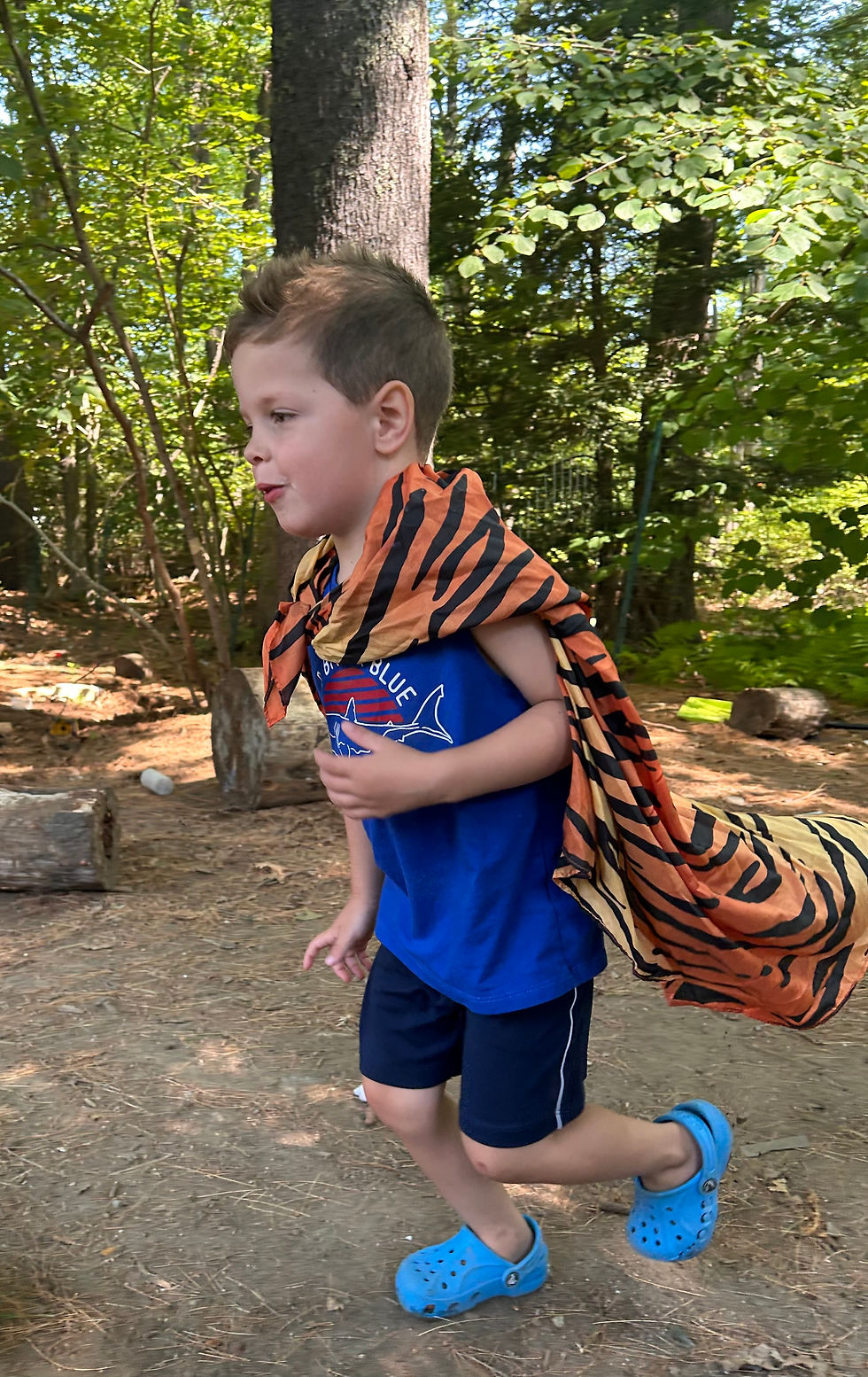
Unstructured, Child-led Play is Key
In order for children to build these skills, they need to use these skills.
It's not enough for adults to tell children to play. It's not enough to provide a dramatic play center that is dressed as a post office for the week or to give students five stations to choose from. Heck, it's not even enough to just go outside with your kids.
The adult needs to step back.
Autonomy ultimately drives deeper brain engagement and development. Which means the child themselves needs to own the experience.
They need to practice these skills without adult interaction or interference. If the adult chooses the activity, the child misses the opportunity to practice decision making, rule creation, problem-solving, etc. If the adult hovers over the child while they play, the child misses the opportunity to learn from their mistakes, to test their ideas, to self-regulate.
If we want children to develop these necessary skills, we need to give them the time and space to do so.
Which means children need play time that is:
Unstructured by an adult
Long enough to actually engage in meaningful play (at least 40 minutes)
Without constant close adult presence or interjection
The Long-term Impact of Play-Built Executive Function
Play isn't just a preparation for school - it is a preparation for life.
Strong executive function predicts:
Academic success
Emotional regulation
Independence
Resilience
Adaptability
All of those skills have life-long positive impacts. But when you're feeling the pressure for your child to perform academic skills (because at this age it is a performance) and academic success is forced down child's throats, it is ok if your preschooler:
isn't doing worksheets
wants to be constantly moving
prefers play over academic work
hasn't written letters yet
doesn't sit still longer than 60 seconds
choosing the same activity over and over
They are still learning. And when you learn how to look for it, the learning and development become clear. Those executive function skills will show themselves in all parts of your child's day - they may be more likely to try a new dinner, follow bedtime routines more easily, manage their emotions when asked to clean up, or figure out how to get their pants right-side out without your help.
Children who play to learn are not falling behind. In fact, they are setting themselves up for academic success beyond just Kindergarten. Children will quickly pick up the information that their academically pressured peers know - and furthermore, they will understand how that information fits into the bigger picture.
So yes, play can and will prepare your child for Kindergarten - and beyond. Play is not a break from learning and it is not a luxury to be earned after academic tasks. It is a necessary piece of early childhood development.
Which do you want for your child? Early academics that result in rote memorization and regurgitation of information - or open, child-led play opportunities that build working memory, inhibitory control, and cognitive flexibility?

Comments