
Learning Without Walls: The Benefits of Time Outdoors for Early Childhood Development
Updated: May 5
Imagine a child at school, learning about ways to respond to emotions such as anger, sadness, and frustration.
Let me guess - you imagined a classroom with four walls. I’ll go even further to guess that most likely, you imagined a teacher at the front of a room or the head of a circle. Maybe the teacher is showing pictures of different faces with emotions and discussing how to use their words with friends instead of pushing or hitting.
Now, imagine a child outdoors. And I’ll assume your mind shows you scenes of recess or playing in the backyard after school.
Why are these distinctions so strong in our minds? That learning must take place in a classroom with walls while time outdoors is assumed to be a break from learning or an earned luxury once learning is finished for the day?
Here’s what it might look like if we combined these two scenarios - learning emotional response skills outdoors:
A small group of children are outdoors, in an environment that they live in five days a week at school. They are trying to build an obstacle course out of a few logs and lines drawn in the dirt. One child, who is typically the leader, is dictating where each log will go, but another child wants to put the logs closer together. They argue. One is angry that there is pushback on her idea, and the other is frustrated that his preferences are being ignored.
A nearby teacher hears their conflict escalating and moves closer to provide guidance when needed. If the children are really struggling with what to say while they negotiate, the teacher can give them potential words to use. If the children engage in harmful physical response, the teacher can step in to prevent injury and further assist with conflict management.
Once "resolved," one child is still upset, sad, that their choice wasn't the one ultimately decided on. Yet, they go back to playing together and continuing to negotiate the course.
This is how learning without walls happens. The same lesson but outdoors and organic. Being outdoors, playing, experiencing, living - doesn’t mean a break from learning. Learning is happening all the time. We just have to get better about noticing it, communicating it, and valuing it.
The environment matters more than we think.
When children are outside consistently, the environment itself starts doing a lot of the “teaching” and lays the foundation for children to truly thrive. Not in a magical way, not in a “perfect world,” but in a real, practical way.

The Weather
Traditional preschool often involves some sort of “circle time.” Stories, songs, the calendar, and the weather. We’ve taken something so natural, a little obvious, and experiential—and made it an arbitrary concept dumbed down to picture cards with Velcro dots on the back.
In reality, there is no need to make the weather into flashcards or a scheduled conversation. When outside, discussion of the weather happens organically. I don’t need to make a point each day to tell a child that today is sunny - they are in the sun.
Instead, children spending long periods of time outside are learning how to adapt to the weather. How to keep their bodies safe and comfortable. How to change their play to fit the weather and take advantage of the new experiences and materials each weather pattern brings. When it rains, they use water in their play. When it snows, they use the snow to build. When it’s windy, they use fallen sticks or the wind itself as a medium for science experiments.
Being outdoors in all weather teaches children how to be resilient. I don’t think my students (who spend six or more hours outside each school day) even know what the concept of a “bad day” is. They wouldn’t look outside at the rain and think it’s a “gross” day and choose to stay inside. They know how to power through and how to find the good in whatever comes their way.
Think of a child working on a piece of artwork and then the wind sweeping it into a puddle. For most children, this would be an utter disaster. There would be a meltdown, tears, maybe screaming, maybe giving up. For children used to the unpredictability of weather, these are the moments when they show how much resilience they have learned. The ability to look past art getting “ruined” or hard work “wasted” and instead see it as just something that sometimes happens because of the environment - and then get back to work, accept it as is, or start again, that is an inarguable measure of growth.
When a child can advocate for themselves and verbalize that their hands are cold, and then find a warmer pair of mittens, they are demonstrating a learned skill that would never come up in a standardized test. When a group of children notice the ground is slippery because of newly formed ice and can adjust their play to ensure they aren’t falling, they are showing a sense of self-protection, awareness, and social care that worksheets will never scratch the surface of.
Weather isn’t just a topic to be stuck on a board, it should be experienced, lived. That is how children will truly learn not only what to call the weather outside, but what it actually means for them.
Uneven Surfaces
One of the greatest advantages of being outdoors, in natural environments, is the unpredictability of it. It forces children to stay aware, consistently evaluate, and utilize their bodies’ abilities.
If we want children who can eventually sit in chairs for long periods of classroom instruction, we first need them to develop the muscles and body control to be able to do so. Weak core muscles lead to children falling out of their seats, or exerting so much energy simply trying to sit that they are fatigued and unable to absorb the material being taught.

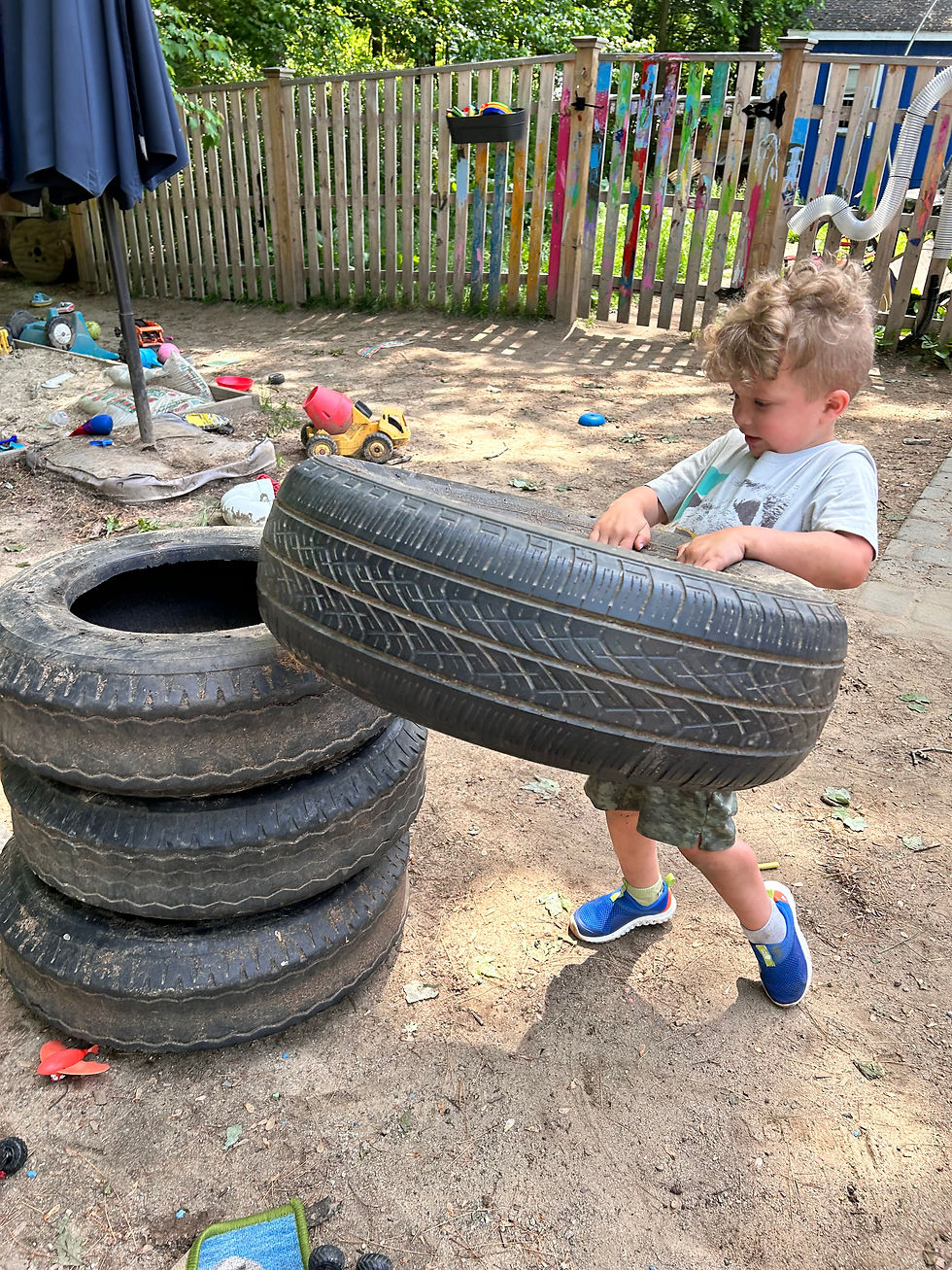
All academic work stems from strong muscles and the ability to focus. When children are moving and interacting outdoors, the opportunities for muscle development and proprioceptive input are tenfold compared to indoor learning environments. Moving logs, digging in the sand, running, jumping, climbing - all contribute to muscle development.
Writing requires the use of all muscles from your core all the way to your fingertips. If you were to take one hand, start at your belly button and run your hand all the way up to your neck and then down your opposite arm to your fingers - that path includes all of the muscles needed for writing (including front and back). Without proper development of those muscles, we are asking children to work against the current by jumping to writing practice. If you’ve ever played a sport, this preschool development is like conditioning work. Without it, you may know the skills to play but lack the ability to maintain accuracy, keep up stamina, and stay focused.
Additionally, proprioceptive input (the body’s sense of where it is and how it moves in space) is developed through movement. The lack of movement opportunities in an indoor classroom robs children of the opportunity to strengthen their proprioceptive sense. A large benefit to a well-tuned proprioceptive sense is the ability to filter out pieces of the environment. If a child’s sense of body awareness in the environment can happen without thinking about it, their brain is freed up to focus on other things - like the task in front of them. Otherwise, their focus is split between their work and their environment. Outdoor areas provide ample opportunities for natural resistance, heavy work, and dynamic movement - all of which help develop that proprioceptive sense, and in turn, develop the ability to focus.
Regulation Discovery
With the outdoors, comes SPACE. There’s less overwhelm from other children, less noise, and less visual clutter. Children playing outdoors are more likely to stay regulated.
The feeling of a breeze on your skin, the sound of rustling leaves, the smell of grass, and the sight of trees against the blue sky are all calming, regulating triggers of our senses.
Where an indoor classroom may need sensory bins or specific sensory activities, an outdoor classroom has natural sensory components all day long. Children’s nervous systems are being consistently regulated without the need of additional materials or a written curriculum objective.
Children are able to retreat to their own space, to focus on what feels calming to them, and to seek those sensory inputs more freely when given the time to do so independently. A “calming corner” indoors is meant to provide a space for that sort of retreat, for a child to learn how to self-regulate. Outdoors, that space could be something different for each child - a spot in the grass, a seat under a tree, a high point with a wide view.
Being outdoors allows children an opportunity to learn what works best for their body, without adult interference or special materials that may only be available in their classroom. Instead, they develop skills that they can use beyond the classroom and learn what environment to seek out when needed.
Immune Support
Not only does the open air and space outside limit the passing of germs, but the dirt actually contains immune boosting properties.
Compared to being on top of one another indoors, when children spend their days outside, even groups of children don’t cough, breathe, or sneeze on each other as much. The air is constantly circulating and the UV light from the sun can actually kill some germs.
Furthermore, studies have shown that children who play in natural dirt or soil actually have stronger immune systems. Exposure to the bacteria in nature helps the immune system develop ways to fight off common viruses.
So if we want our children to be healthy, happy, well-developed human beings, we need to get them outside. Not just for 20 minutes of recess, but for long extended times of the day where they can truly reap the benefits of being outdoors.
The benefits of outdoor learning lay the foundation for further school - even if the school environment shifts to longer periods indoors. Preschool, at the very least, should be full of outdoor learning time.

Comments